
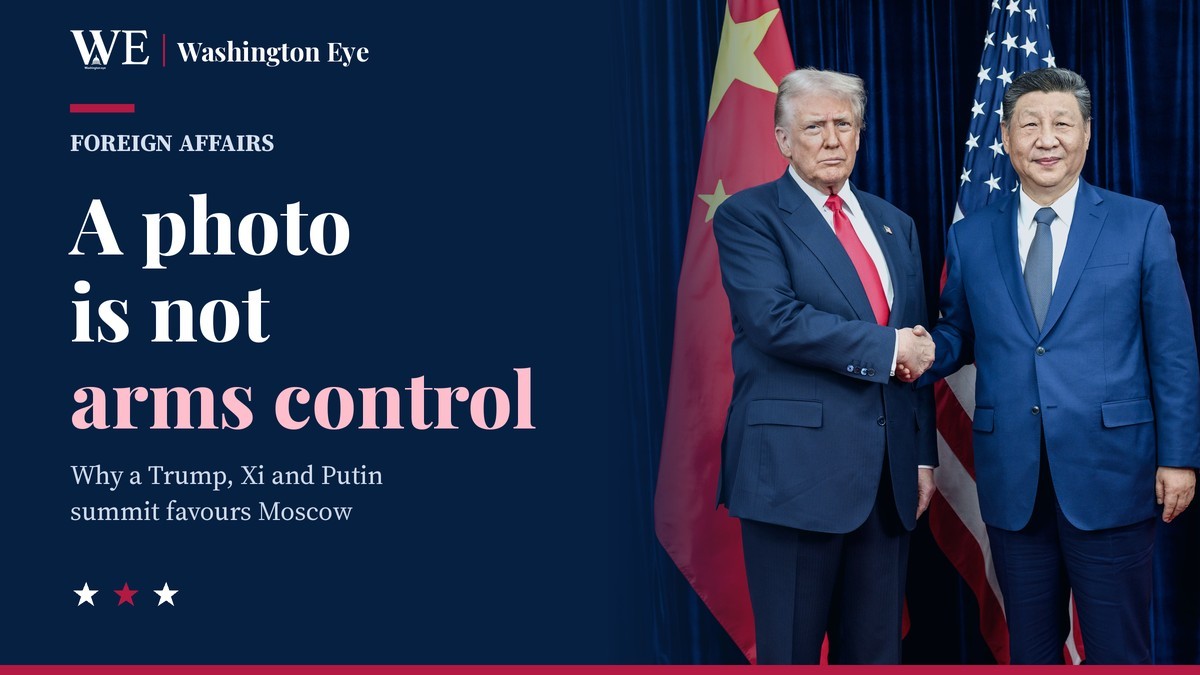
Somewhere in Beijing, protocol officers are already measuring the distance between three chairs. China has confirmed for the first time that it is discussing a meeting between Xi Jinping, Donald Trump and Vladimir Putin on the sidelines of the Asia-Pacific Economic Cooperation summit it hosts in Shenzhen on 18 and 19 November. Nothing is fixed. But if the three men sit down together, it will be the first such meeting of the leaders of the world's three largest nuclear powers, and the White House will present it as statesmanship. It should be judged by a simpler standard: who gets what out of the picture.
On the evidence so far, the answer is uncomfortable for Washington. The Russian side first raised the idea of a three-way summit, according to officials from all three countries cited in reporting this week. The Kremlin has framed the gathering around ending the war in Ukraine on terms that suit Moscow. Mr Trump has framed it around nuclear weapons. China, the host, has said plainly that it will not join the kind of arms control talks the president says he wants. Three leaders, three agendas, and only one of them, Mr Putin, walks away a clear winner from the photograph alone.
The confirmation came from Mao Ning, a spokesperson for China's foreign ministry, who told reporters in Beijing this week that China "is in communication with relevant parties regarding a meeting between the three heads of state." Kremlin spokesman Dmitry Peskov said earlier that work was under way to organise it. Mr Trump, asked about the idea in October, was enthusiastic. "We would have it to talk about nuclear weapons and denuclearisation," he told reporters outside the White House. "If President Xi wants to have it, I'd have it. I'm sure we'd talk about other things like trade too."
That is a fair goal. The last major treaty limiting American and Russian strategic nuclear forces expired earlier this year, and no replacement exists. China's arsenal is growing. A world with three nuclear peers and no rules among them is more dangerous than the Cold War, when at least two sides talked. If a summit in Shenzhen could start a real process, even a slow one, it would deserve support from Democrats and Republicans alike.
But Beijing has already answered the question. China's foreign ministry has said that its "nuclear strength is by no means at the same level with that of the US and Russia" and that it would be "neither fair, reasonable nor realistic" to ask China to join so-called trilateral nuclear disarmament negotiations at this stage. Its position, repeated in an official report on the Non-Proliferation Treaty in April, is that Washington and Moscow should first make deep cuts of their own. Nothing in the past week suggests that has changed. Sun Yun, director of the China program at the Stimson Center, said China would not engage on arms control, Ukraine or Iran beyond its familiar refrain that peace is important and wars should end. "China wants the image but not the costs," she said.
If China wants the image without the cost, Russia wants the image because it is the prize. Danny Russel, a former senior State Department official who served under President Barack Obama and is now a distinguished fellow at the Asia Society Policy Institute, put it bluntly: "Putin has the most to gain from a leaders' trilateral, and the Russians are clearly behind the push for a meeting, which would be a diplomatic coup." Mr Russel added that Mr Trump's advisers have clearly warned him to keep Ukraine off the agenda.
It is easy to see why they would. Mr Putin raised the idea of using such a meeting to settle the war in a way that favours Moscow during a 9 October phone call with Mr Trump, according to reporting on that conversation, the same call that produced a deal on Russian diesel and was followed by an easing of some sanctions. Ukraine would not be in the room in Shenzhen. A photograph of the Russian president seated as an equal between the leaders of the United States and China, while his forces continue to strike Ukrainian cities, would tell every government watching that isolation has failed. Craig Singleton, senior director of the China program at the Foundation for Defense of Democracies, a hawkish think tank, argued that such photo opportunities have "diminishing diplomatic returns." That is true for the people in the picture who already enjoy legitimacy. It is not true for the one who has spent four years trying to buy it back.
The timing makes the danger sharper. On the same Saturday that China confirmed the talks, a Russian missile attack damaged a residential building in Kyiv, injuring two people and damaging a building housing a kindergarten, according to the city's mayor, Vitali Klitschko. Russian strikes also hit energy facilities serving the capital's heating and water systems, and an important bridge. President Volodymyr Zelenskyy had warned the night before that Russia was preparing new strikes "on energy, on bridges across the Dnipro, on civilian infrastructure," and repeated his plea for missiles for the American-made Patriot air defence system.
The Shenzhen idea also sits awkwardly on top of a negotiation that is actually taking place. American mediators led by envoys Steve Witkoff and Jared Kushner are due to host Russian and Ukrainian delegations in Abu Dhabi on 10 and 11 November, the first three-way peace talks in months. Mr Kushner said in a social media post after meetings in Brussels that the United States and its partners were exploring confidence-building goals for Europe, and he insisted that "any arrangements must fully respect the sovereignty, territorial integrity, and independent decision-making of every nation."
Mr Zelenskyy has been precise about what Kyiv needs. "What matters is that it's clear on paper," he said in a television interview this week. "If Russia starts attacking again, what will happen? Who will do what, with what means, and when?" Those are questions for negotiating teams with maps and lawyers. They are not questions three leaders answer over a choreographed half hour at a regional economic summit. The risk is that a leaders' photograph a week after Abu Dhabi becomes a substitute for that hard work, and that whatever was agreed by the negotiators gets rewritten by impressions formed at the top table.
Mr Trump's own words make that risk real. After meeting privately at the White House this week with Kirill Dmitriev, a close envoy of Mr Putin, the president said a coming agreement would be "a big agreement" that "might involve all of Europe," and that "everyone's going to be thrilled." He did not meet the Ukrainian officials who were in the building the same day. Allies in Europe have learned to treat such remarks with caution, and Ukrainians with something closer to alarm.
There is a further complication. Mr Trump will be in Shenzhen above all to meet Mr Xi, for the third time this year, and to keep alive a trade truce that is due to expire in January. That truce is fragile. On Friday, the US Trade Representative, Jamieson Greer, used a video call with Chinese Vice Premier He Lifeng to urge Beijing to take "concrete actions to fully implement its past commitments, particularly as they relate to agricultural purchases, rare earths, and other critical minerals." China's official news agency said Beijing had raised its own concerns about American restrictions.
When a president needs something from his host, the host gains leverage over everything else on the schedule. Beijing can make the trade talks smoother if the trilateral goes the way it wants, which means a dignified image of three great powers and no pressure on China's arsenal. Ms Sun noted that China's biggest worry is perception: the summit, she said, "should not be equated to three great powers dividing up the world." That is precisely how much of the world will read it if Ukraine is discussed without Ukrainians, and if American farmers and rare earth supply chains become bargaining chips in a meeting sold as being about nuclear safety.
All of this unfolds days after Mr Trump's party lost control of both chambers of Congress. Robert Kagan, a senior fellow at the Brookings Institution, has warned that Russia and China could become more aggressive over the next two years if they conclude that the president is politically weakened and "on his way out." A leader who appears eager for a historic photograph, and for any deal that can be called big, is exactly the counterpart that Moscow and Beijing would hope to meet in that moment.
The incoming Democratic majorities are widely expected to push for more aid to Ukraine and to question the diesel deal and the sanctions relief. They cannot stop the president from travelling or from sitting down with whomever he likes. But they can do something useful before Shenzhen: insist, in public and through the committees they will soon chair, on clear terms for any American participation. The administration should state in advance that Ukraine's future will not be negotiated at a table without Ukraine, that sanctions will not be eased further as a summit courtesy, and that any arms control language must include verifiable steps rather than aspirations.
None of this means Mr Trump should refuse to meet. Talking to adversaries is not a gift to them; talking to them without a plan is. A serious approach would separate the tracks. Arms control should go to a standing process among officials, with an agreed first step such as data exchanges, notification of missile tests or a pledge to keep human control over nuclear launch decisions, ideas that do not require China to accept limits it has already rejected. Ukraine should stay in the Abu Dhabi channel, where Kyiv has a seat. Trade should be handled bilaterally with Beijing, on its own merits.
A three-way meeting that endorsed such a structure would be worth having, even if it were only a handshake. A meeting that produces a photograph, a vague statement about peace and a quiet understanding about Ukraine would be worse than no meeting at all. As Mr Singleton put it, "The spectacle may be historic without producing anything particularly consequential." The worry for Ukrainians, and for anyone who cares about the rules that keep nuclear powers in check, is that the spectacle will be consequential after all, just not in the way the White House promises.