
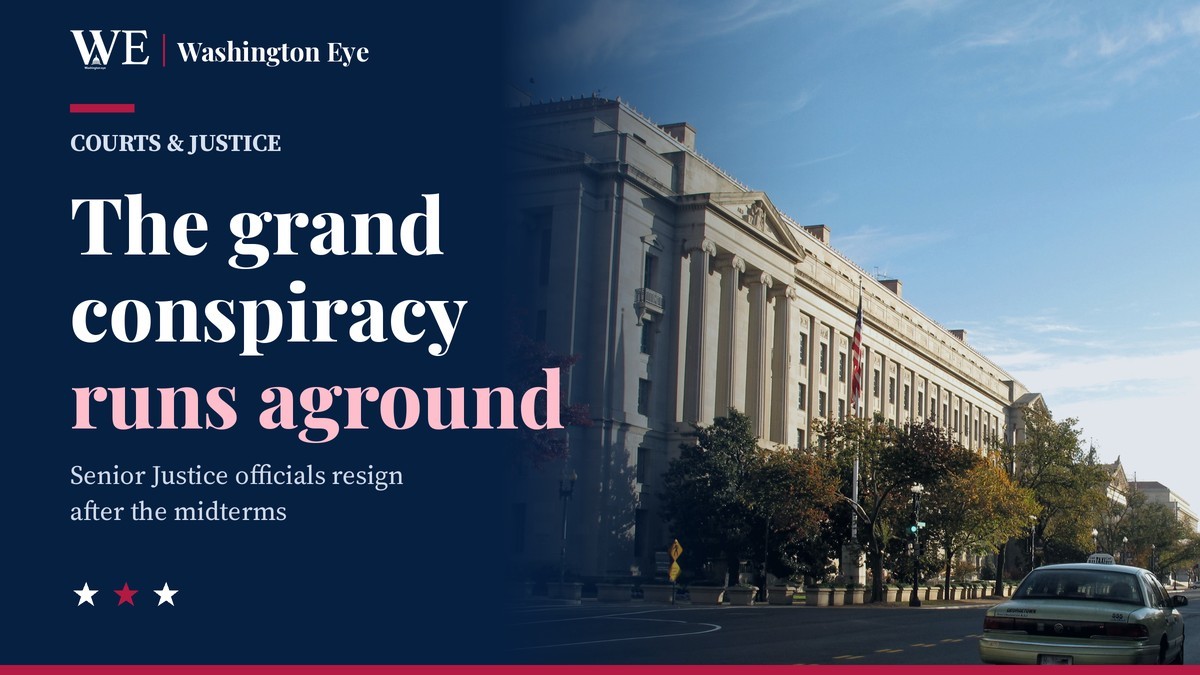
Three senior Justice Department officials left their posts in the same midterm week. On Friday Attorney General Todd Blanche announced that Jason Reding Quiñones, the U.S. attorney for the Southern District of Florida, had resigned, and that John Eisenberg, the assistant attorney general for the National Security Division, had done the same. On Thursday Harmeet Dhillon stepped down as assistant attorney general for the Civil Rights Division. The cluster of exits, coming days after Democrats took both chambers of Congress, marks the clearest personnel reset at the department since the start of the second Trump term.
Quiñones was not an ordinary U.S. attorney. Confirmed last year to lead the Miami-based district, he was handed the politically charged assignment of supervising what the administration has called the grand conspiracy investigation: an effort to treat prior federal inquiries into Donald Trump, stretching from the 2016 campaign through the special counsel cases that followed, as parts of a single unlawful plot against the president. No charges have been brought under that theory. The probe has moved in fits and starts for more than a year, slowed by staff turnover, delayed grand jury appearances and public arguments inside the department about whether the evidence could support a case.
People familiar with the matter have described growing frustration in Washington with how Quiñones managed the Florida office assigned to the work. In recent weeks investigators postponed scheduled grand jury testimony from several witnesses. Last April a lead national security prosecutor on the related inquiry into former CIA Director John Brennan was replaced after raising questions about the strength of the case. Shortly afterward Joseph diGenova, a former U.S. attorney for the District of Columbia, took over the Florida-centred effort. He left the department in September without filing any criminal charges, later saying that headquarters had tried to take over the investigation and that lanes had been crossed.
Blanche framed Quiñones's departure as a routine thank-you for service. In a social media post the attorney general said the department was grateful for leadership against violent crime, drug trafficking, sex trafficking and transnational crime, and singled out the May indictment of former Cuban president Raúl Castro over the 1996 shootdown of civilian planes flown by Miami-based exiles, the Brothers to the Rescue. Quiñones answered in the same register. He said he was leaving with immense pride in what the office had accomplished and profound gratitude for the chance to serve, and thanked President Trump for his trust along with the men and women of the Southern District of Florida for their dedication to justice and the rule of law.
The Castro indictment was a signature case for the Miami office under Quiñones. It was also a reminder that the district has always mixed national-security politics with ordinary federal prosecution. What distinguished the grand conspiracy assignment was the scale of the ambition and the thinness of the results. The theory asked prosecutors to weld together conduct more than a decade old, including actions around the 2016 campaign, with the later special counsel investigation led by Jack Smith that produced now-dismissed charges over efforts to overturn the 2020 election and the handling of classified documents recovered from Mar-a-Lago. Trump denied those charges. Connecting them into a single criminal conspiracy against his rights was always going to require proof that separate investigators shared a common illegal purpose, not merely that they shared a target.
Critics of the project have said as much for months. Stacey Young, a former Justice Department lawyer who heads the group Justice Connection, said Quiñones would be remembered as the president's Don Quixote for tilting at the windmill of the so-called grand conspiracy, and that his departure followed the path of others who signed up for an impossible dream. She urged whoever replaces him to heed Robert Jackson's counsel that prosecutors should choose cases in which the offence is the most flagrant, the public harm the greatest and the proof the most certain. That standard is not a progressive slogan. It is the classical American description of how a federal prosecutor decides what to charge.
Eisenberg's resignation lands in a different register. Sworn in as head of the National Security Division in June 2025, he oversaw cases involving espionage, terrorism, export controls, cybercrime and related threats. The most closely watched prosecution under his watch was the case against former national security adviser John Bolton, who pleaded guilty this year to mishandling classified information and is awaiting sentencing. Blanche said Eisenberg had served with distinction and strengthened the country's ability to address foreign and domestic threats. There has been no public suggestion that Eisenberg's exit was driven by the same internal frustrations described around the Florida conspiracy probe. Timing still matters. A national security chief departing the same Friday as the Miami U.S. attorney, days after a midterm rout, reads in Washington as part of a broader reckoning even if the personal reasons differ.
Dhillon's Thursday departure closes a more ideological chapter. As head of the Civil Rights Division she led a radical overhaul of the unit's priorities, shifting it toward the administration's fights over election administration and away from the enforcement agenda that defined the division for much of the past half-century. The division pressed cases and inquiries around non-citizen voting, a practice that is rare in American elections but that Trump repeatedly described as a major problem before the midterms. It also attempted to bring an indictment against Cassidy Hutchinson, a former White House aide who became a prominent witness before the House committee that investigated the 6 January 2021 Capitol attack. That effort failed. The combination of an overhaul that never produced the signature courtroom wins its architects promised, and a midterm verdict that put Democrats in charge of both chambers, left little political room for Dhillon to stay.
The midterm context is not background colour. It is the reason these resignations arrive together. Democrats took the House and the Senate. Public counts put Democrats at least at 54 Senate seats, with the possibility of 56 if outstanding contests in Mississippi and Alaska flip. A Democratic Congress will control the Judiciary Committees in both chambers, the appropriations process that funds the department and the subpoena power that reaches into case files, emails and personnel decisions. Officials who spent two years building prosecutions of the president's political adversaries now face oversight from lawmakers who campaigned against those prosecutions. Leaving before a Democratic committee chair starts asking for documents is a rational career choice, whether or not anyone says so out loud.
The personnel map around the department is already thinner than it looks on paper. The Florida conspiracy team has turned over more than once. A case against two former FBI officials whom House Republicans accused of lying to Congress was dismissed by a judge. Separate matters involving former FBI Director James Comey remain pending in other districts, including a case tied to alleged authorisation of contacts with a reporter in 2016 and another involving an Instagram photo that the administration has characterised as a threat. Those cases are not the grand conspiracy, but they sit in the same political weather system: high-visibility targets, contested legal theories and a department that will soon answer to a Congress controlled by the other party.
There is a narrower institutional point that should not be lost in the scorekeeping. U.S. attorneys and assistant attorneys general resign for many reasons. Some leave because an investigation has stalled and they do not want their name on the next delay. Some leave because an election changed the political cost of staying. Some leave because they have finished the work they came to do. All three can be true at once. What is unusual here is the concentration. Three senior officials, three different divisions, one midterm week. Blanche's public notes of gratitude read like the closing paragraphs of farewell letters that were already being drafted.
For the incoming Democratic majority the temptation will be to treat the resignations as proof that the second Trump Justice Department was a patronage project all along. That reading is too neat. Departments always become more political at the top when a president returns to office with a long list of grievances. Career prosecutors still run most dockets. The harder question is whether the grand conspiracy model, the Civil Rights Division's election push and the national security docket's high-profile plea can survive contact with Democratic oversight, sceptical judges and a public that has just voted for divided government. Resignations do not answer that question. They only clear the desks of the people who were supposed to.
Replacements will matter as much as the exits. Whoever takes the Southern District of Florida inherits an unfinished conspiracy theory, a completed Castro indictment and a district that remains central to immigration, narcotics and national security work. Whoever takes Civil Rights inherits a division whose priorities have been rewritten and will now be rewritten again. Whoever takes National Security inherits live cases, including Bolton's sentencing, in a world where foreign and cyber threats do not pause for midterms. Blanche will want loyalists who can hold the line. A Democratic Senate that confirms those picks, if confirmation is required, will want something closer to the Jackson standard Young invoked: flagrant offences, clear public harm and proof that can survive a courtroom.
The grand conspiracy was always a bet that narrative could do the work of evidence. It asked the public to see every prior investigation of Trump as a single plot, and it asked prosecutors to charge that plot before the statute books and the facts caught up. DiGenova left without charges. Quiñones leaves with the same empty docket on that file, a celebrated Castro case as the consolation prize and a week of midterm results that make the next chapter of the project much harder to write. Eisenberg and Dhillon leave for their own reasons, in the same political storm. The Justice Department that faces the next Congress will look different at the top. Whether it looks more disciplined about what it charges is the test that still lies ahead.